




Lifetouch Care · Wolverhampton
How Can Medication Support at Home Keep Someone Safe in Wolverhampton?
Medication support at home means helping someone take the right medicine, in the right dose, at the right time, in their own home, while keeping them as involved and independent as possible. Many older people take several medicines a day, and changes in memory, eyesight or dexterity can make keeping track of them hard.
This guide explains when someone might need help with their medicines, what medication support at home involves, eight practical ways to make medicines safer, and where to get help in Wolverhampton.
Why does medication support at home matter?
NICE guidance on managing medicines for adults receiving social care in the community notes that people who receive care at home may be at greater risk of problems with their medicines, for example if they have several long-term conditions or take many medicines. Missed doses, double doses, mixing up old and new medicines and side effects such as dizziness can all lead to falls, illness or a hospital stay.
The right support helps people get the benefit their medicines are meant to give, and helps families feel confident that nothing is being missed.
Signs someone may need help with their medicines
- Tablets left in blister packs, or boxes running out too quickly or too slowly.
- Confusion about what each medicine is for or when to take it.
- Difficulty opening packs, reading labels, using inhalers or applying eye drops.
- Old and new medicines mixed together after a change or a hospital stay.
- New dizziness, drowsiness, falls or confusion after a medicine change.
- Stockpiles of medicines in cupboards, or repeat prescriptions not being ordered.
What does medication support at home involve?
Support should match what the person needs, not take over. NICE recommends that medicines support needs are assessed as part of the person’s overall care assessment, with the focus on how the person can be supported to manage their own medicines. Families can be involved in the assessment if the person agrees. Support usually falls into three levels:
- Reminding (prompting): the person manages their own medicines, and the carer reminds them when a dose is due.
- Assisting: the carer helps with practical tasks, such as opening containers or reading labels, while the person stays in control.
- Giving (administering): the carer selects and gives the medicine, following the prescription and the care plan, and records it.
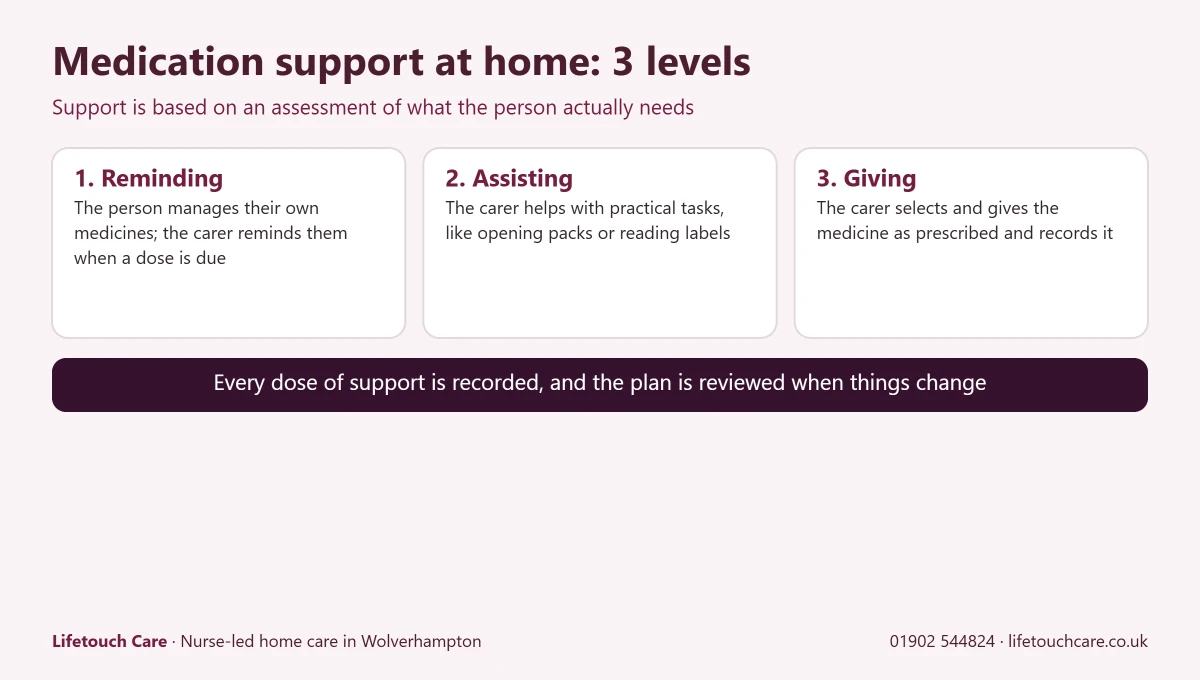
NICE also says the care plan should record who to contact about medicines, what support each medicine needs, how it will be given and who is responsible, and should be reviewed regularly or sooner if things change, such as after a hospital stay.
8 practical ways to make medicines safer at home
1. Keep an up-to-date medicines list
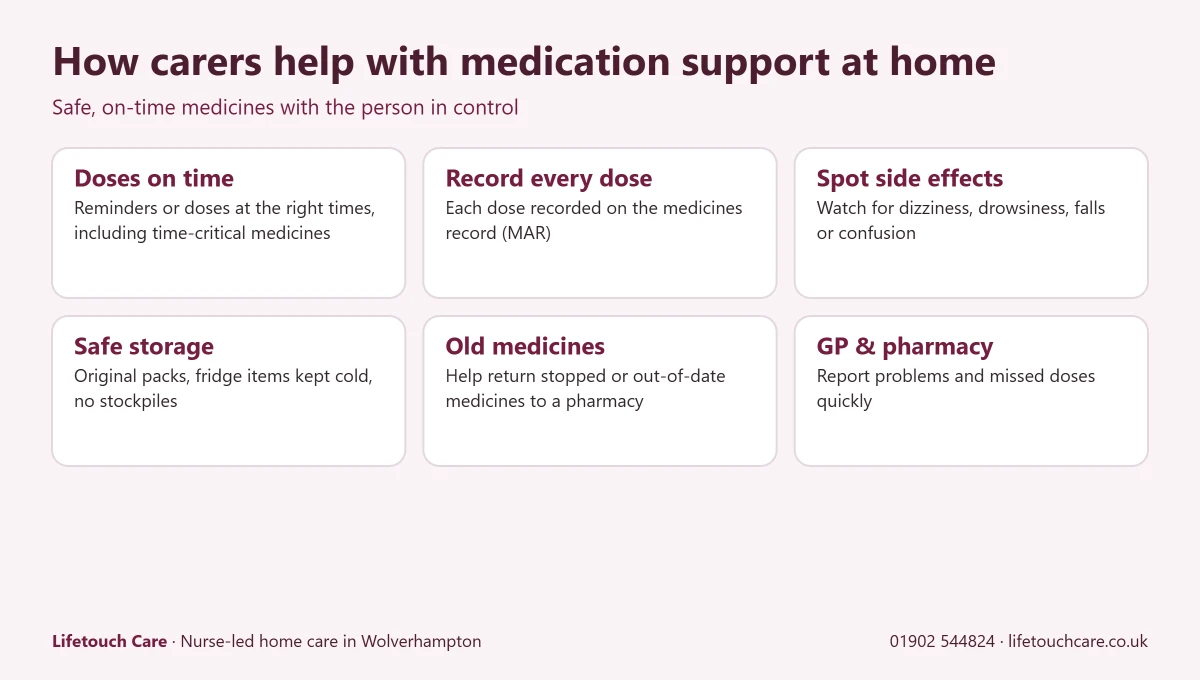
Keep a list of every medicine, including creams, inhalers, eye drops and anything bought from a shop, with the dose and times. Update it after every change. The NHS App can show the medicines prescribed by the GP practice. Take the list to every appointment and into hospital.
2. Ask for a medication review
A structured medication review with the GP or practice pharmacist looks at all of a person’s medicines together. NICE explains that these reviews can identify medicines that could be stopped or need a dose change, or new medicines that are needed. Ask for one if someone takes several medicines, has had a fall, or seems to have side effects.
3. Use the right aids
Reminder alarms, large-print labels, easy-open lids and inhaler aids can all help people stay independent. Blister packs (sometimes called dosette or monitored dosage systems) are not right for everyone. NICE advises that they should only be used after a health professional, such as a pharmacist, has assessed that the person needs one.
4. Know which medicines are time-sensitive
Some medicines must be taken at exact times, and a missed or late dose can cause serious harm. NICE gives insulin as an example, and Parkinson’s medicines are another. Make sure everyone who supports the person knows which medicines are time-critical. Our guides to Parkinson’s care at home and diabetes care at home explain more.
5. Record every dose
When carers support with medicines, NICE says they should record the support given for each medicine on every occasion, usually on a medicines administration record (MAR). If a family member gives a dose, for example on a day out, agree in advance how it will be recorded so nothing is doubled or missed.
6. Store medicines safely and order only what you need
Keep medicines in their original packaging, in a cool, dry place out of reach of children and pets. Keep fridge medicines in the fridge. Order repeat prescriptions in good time, but only order what is needed, to avoid stockpiles and confusion.
7. Return unwanted medicines to a pharmacy
Old, out-of-date or stopped medicines should go back to a pharmacy, which will dispose of them safely for free. Do not put medicines in the bin or flush them down the toilet. Clearing out old medicines after a change helps prevent mix-ups.
8. Report side effects and problems quickly
Tell the GP or pharmacist about new symptoms such as dizziness, drowsiness, falls, confusion or upset stomach, especially after a medicine change. NICE says care workers should report concerns such as refused or missed doses, errors and possible side effects. Anyone can report a suspected side effect through the MHRA Yellow Card scheme. Never stop a medicine without advice.
What about medicines after a hospital stay?
Medicines are often started, stopped or changed in hospital. When the person comes home, check the discharge letter against the medicines at home, remove anything that has been stopped, and ask the pharmacist if anything is unclear. Our guide to care after hospital discharge covers what to check in the first few days.
Can medicines be hidden in food or drink?
Giving medicines hidden in food or drink without the person knowing is called covert administration. NICE says it should only happen in line with the Mental Capacity Act 2005, after a capacity assessment, advice from the prescriber, a best interests decision and a set date for review. Care workers must not decide to do this themselves. If someone is refusing medicines, talk to the GP or pharmacist about the reasons and the alternatives, such as liquid forms.
Getting help with medicines in Wolverhampton
The GP practice and its practice pharmacists can review medicines and answer questions, and your local community pharmacy can give advice, help with repeat prescriptions and take back unwanted medicines. If someone needs help at home with medicines and daily care, City of Wolverhampton Council adult social care can carry out a needs assessment, or you can arrange private care directly. The NICE information for the public on medicines support at home explains what to expect.
How can care at home help with medicines?
Carers who visit regularly can make sure doses are not missed, notice side effects early and keep the GP, pharmacy and family informed. At Lifetouch Care, a nurse assesses what medicines support each person needs before care begins, and our carers are trained and checked as competent before they help with medicines. Every dose is recorded on a digital medicines record (eMAR), which our team checks regularly.
Visiting homecare
Visits can be timed around medicines, for example a morning call for breakfast and tablets and an evening call for evening doses. Our visiting homecare service is flexible and can change as needs change.
Live-in care
For people with complex or frequent medicine routines, or who need help through the night, live-in care means someone is always there.
Nurse-led care
Where medicines are complex, for example with several long-term conditions, tube feeding or medicines that need clinical monitoring, nurse-led care adds clinical oversight. Our guide on heart failure care at home shows how medicines support fits into managing a long-term condition.
Coming home from hospital
Our hospital discharge support helps people settle home safely and get their new medicine routine right from the first day.
Supporting family carers
Keeping track of someone else’s medicines, especially from a distance, can be a worry. Planned respite care can give you a break while your relative’s medicines carry on safely, and our guide to the signs an elderly parent may need care at home may help you decide on next steps.
Lifetouch Care: Medication Support at Home in Wolverhampton
Lifetouch Care is a CQC-registered, nurse-led home care provider based in Wolverhampton. Our medication support at home starts with a nurse-led assessment, and our trained carers help people take their medicines safely and on time, record every dose and report any concerns, while keeping families, GPs and pharmacists informed. We respect each person’s culture, language, faith and food preferences.
To discuss medication support at home for yourself or a relative, call 01902 544824 or get in touch online.
Frequently asked questions
What is medication support at home?
Medication support at home is help to take the right medicine, in the right dose, at the right time, in a person’s own home. It can range from a reminder to having medicines given by a trained carer.
What are the levels of medication support?
Support usually falls into three levels: reminding (prompting), assisting with practical tasks such as opening packs, and giving (administering) medicines in line with the prescription and care plan.
How do I know if my parent needs help with their medicines?
Signs include tablets left in packs, running out too early or too late, confusion about doses, difficulty opening packs, and new dizziness or falls after a medicine change.
What is a medication review?
A structured medication review with the GP or practice pharmacist looks at all of a person’s medicines together and can identify medicines that could be stopped, need a dose change, or are needed.
Are blister packs a good idea?
Blister packs are not right for everyone. NICE advises they should only be used after a health professional, such as a pharmacist, has assessed that the person needs one.
What is a MAR chart?
A medicines administration record (MAR) is where carers record the support given for each medicine on every occasion, so it is clear what has been taken and nothing is missed or doubled.
What should I do with old or unwanted medicines?
Take them to any pharmacy, which will dispose of them safely for free. Do not put medicines in the bin or flush them down the toilet.
Can carers hide medicines in food?
Only in line with the Mental Capacity Act 2005, after a capacity assessment, advice from the prescriber and a best interests decision. Care workers must not decide to do this themselves.
How do I report a side effect?
Tell the GP or pharmacist. Anyone can also report a suspected side effect through the MHRA Yellow Card scheme. Never stop a medicine without advice.
How can families in Wolverhampton arrange medication support at home?
Contact Lifetouch Care on 01902 544824 or through our contact page to arrange a nurse-led assessment and discuss the support your relative needs.