




Lifetouch Care · Wolverhampton
How Can Parkinson’s Care at Home Help Someone Live Well in Wolverhampton?
Parkinson’s care at home means helping someone with Parkinson’s to keep moving, take their medicines on time and stay safe and independent in their own home as the condition changes. Parkinson’s affects everyone differently, and good days and bad days can change from hour to hour, so support works best when it fits around the person’s own routine.
This guide explains how Parkinson’s can affect daily life, eight practical ways to support someone at home, why medicine timing matters so much, and the NHS and care at home support available in Wolverhampton.
Why does Parkinson’s care at home matter?
Parkinson’s UK estimates that around 166,000 people in the UK have a Parkinson’s diagnosis, and expects this to reach about 173,000 by 2030 as the population ages. The average age of someone living with Parkinson’s in the UK is 77.
The NHS explains that Parkinson’s is a progressive condition, and symptoms can get worse over time, making everyday tasks harder without help. There is no cure yet, but medicines and therapies can reduce symptoms and support quality of life. Most of the work of living well with Parkinson’s happens at home, every day, which is why the right routine and support make such a difference.
How can Parkinson’s affect daily life?
The main movement symptoms are tremor (shaking), slow movement and stiff muscles. The NHS also lists balance problems, which raise the risk of falls, along with depression and anxiety, loss of smell, sleep problems and memory problems. Other common difficulties include:
- Freezing, when the feet feel stuck to the floor, especially in doorways or when turning.
- Speech and swallowing changes, such as a quieter voice, slower eating or coughing at meals.
- Tiredness and poor sleep, which can make the day feel much harder.
- Constipation and bladder problems.
- Dizziness on standing, which can add to the risk of falls.
- “On” and “off” times, when symptoms are well controlled for part of the day and much worse when a medicine dose wears off.
8 practical ways to support Parkinson’s care at home
1. Give Parkinson’s medicines on time, every time
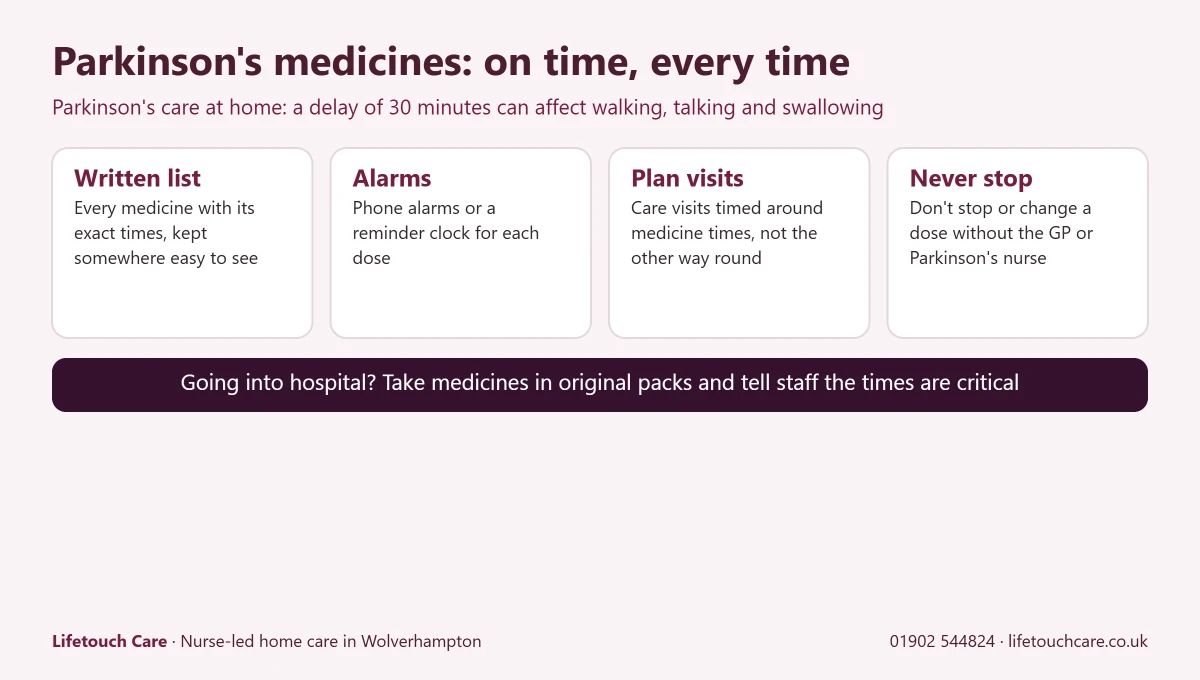
Parkinson’s medicines are time-critical. Parkinson’s UK warns that a delay of as little as 30 minutes can cause some people to lose the ability to walk, talk or swallow, and its Get It On Time campaign explains why. Keep a written list of each medicine and its exact times, use phone alarms or a reminder clock, and never stop or change a dose without speaking to the GP, Parkinson’s nurse or consultant. If you use home care, make sure visits are planned around medicine times, not the other way round.
2. Keep moving with physiotherapy advice
Staying active helps with strength, balance and stiffness. Ask the GP or Parkinson’s nurse for a referral to a physiotherapist, who can suggest exercises and tips for walking, turning and getting out of a chair. Regular gentle activity, such as a daily walk, chair exercises or a local Parkinson’s exercise class, can help people feel steadier and more confident.
3. Make the home safer and reduce falls
Balance problems and freezing make falls more likely. Clear trip hazards, improve lighting, fit grab rails, and leave space to turn in small rooms. An occupational therapist can suggest equipment such as a raised toilet seat, a perching stool or bed rails, and techniques to help with freezing. Our guide to falls prevention at home has a room-by-room checklist.
4. Support safe eating, drinking and swallowing
Swallowing can become slower or harder. Allow plenty of time for meals, sit upright, and offer smaller mouthfuls. Coughing or choking at meals, a wet-sounding voice or repeated chest infections should be reported to the GP, who can refer to a speech and language therapist. Ask the pharmacist if tablets are hard to swallow, rather than crushing them, as some Parkinson’s medicines must not be crushed.
5. Help with speech and communication
A softer, quieter voice and fewer facial expressions can make conversation harder and people may withdraw. Reduce background noise, face the person, give them time and avoid finishing their sentences. A speech and language therapist can offer voice exercises and other support.
6. Plan around tiredness, sleep and constipation
Plan demanding tasks, such as showering or going out, for “on” times when medicines are working well, and build in rest. Good sleep routines help, and the GP can review problems such as night-time stiffness or vivid dreams. Plenty of fluids, fibre and regular activity help with constipation, which is very common in Parkinson’s.
7. Look after mood and memory
Low mood, anxiety and memory or thinking changes can be part of Parkinson’s itself. Watch for withdrawal, loss of interest, confusion or hallucinations, and speak to the GP or Parkinson’s nurse. Keeping up hobbies, friendships, faith and familiar routines helps people feel more like themselves.
8. Plan ahead for hospital stays
If the person goes into hospital, take all their medicines in their original packaging and a written list of exact dose times. Parkinson’s UK advises asking whether the hospital lets patients take their own medicines, and making sure staff know the times are critical. Our guide to care after hospital discharge covers the first days back home.
Parkinson’s care at home support in Wolverhampton
The GP is usually the first point of contact and can refer to a specialist for diagnosis and review. The Royal Wolverhampton NHS Trust has Parkinson’s clinical nurse specialists who run nurse-led clinics for people who are newly diagnosed and regular review clinics. They can give advice on symptoms, medicines and support, so ask the GP or consultant how to contact them.
The Parkinson’s UK helpline on 0808 800 0303 offers free information and support and can tell you about local groups and exercise classes. The NHS Parkinson’s disease pages explain symptoms and treatment.
How can care at home help with Parkinson’s?
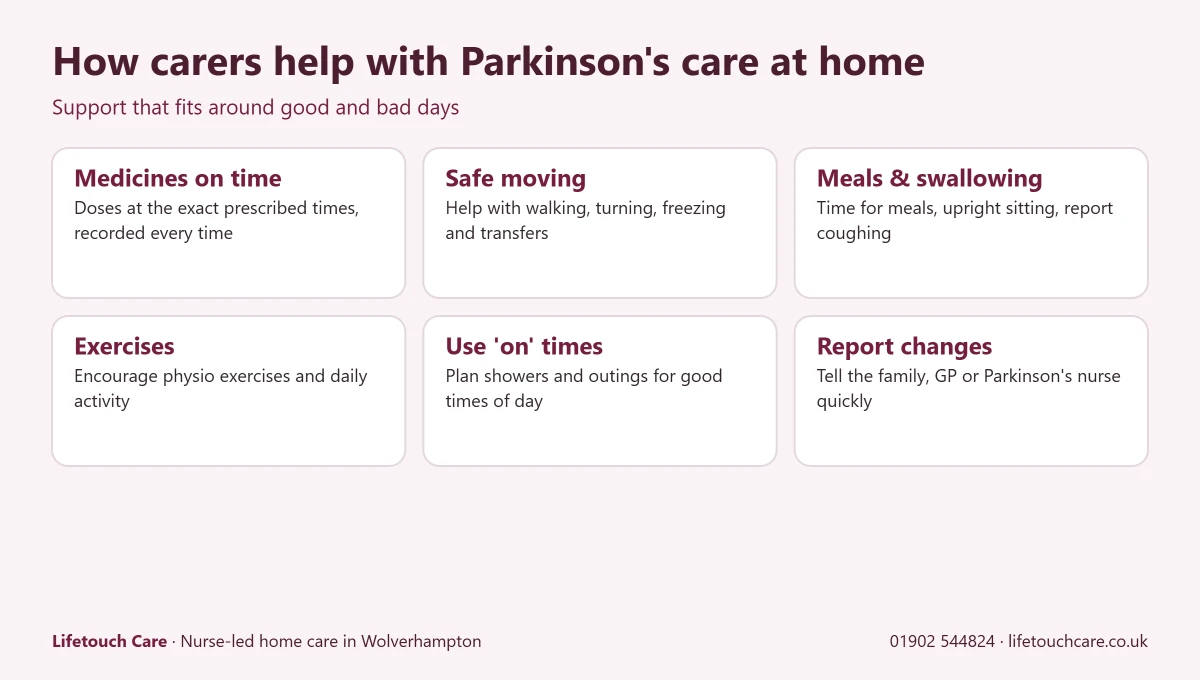
Carers who know the person well can spot the difference between a good and a bad day, help them use their “on” times well and report changes early. At Lifetouch Care, our nurses carry out an assessment before care begins and plan visits around the person’s medicine times and routine, working with the GP and Parkinson’s nurse.
Visiting homecare
Visits timed around medicines can help with getting up and dressed, meals, medicines and exercises. Our visiting homecare service is flexible and can change as needs change. Our guide to medication support at home explains how carers help with medicines safely.
Live-in care
For people who need help through the night, have frequent falls or have complex medicine routines, live-in care means someone is always there to help with moving, medicines and reassurance.
Nurse-led care
As Parkinson’s progresses, some people need extra clinical support, for example with swallowing difficulties, tube feeding, pressure areas or several long-term conditions. Nurse-led care adds clinical oversight and closer monitoring. Our guide to supporting daily routines for someone living with dementia may help if memory changes become part of the picture.
Coming home from hospital
Medicines are sometimes changed or delayed during a hospital stay. Our hospital discharge support helps people settle home safely and get their medicine routine back on track.
Supporting family carers
Caring for someone with Parkinson’s can be rewarding but also tiring, especially when nights are broken. Family carers in Wolverhampton can ask the council for a carer’s assessment; our guide on using a carer’s assessment to access respite care explains how. Planned respite care can give you a break while your relative’s routine carries on safely at home.
Lifetouch Care: Parkinson’s Care at Home in Wolverhampton
Lifetouch Care is a CQC-registered, nurse-led home care provider based in Wolverhampton. Our Parkinson’s care at home starts with a nurse-led assessment, and our carers help people take their medicines on time, move safely, eat and drink well and keep up the activities that matter to them, while keeping families and health professionals informed. We respect each person’s culture, language, faith and food preferences.
To discuss Parkinson’s care at home for yourself or a relative, call 01902 544824 or get in touch online.
Frequently asked questions
What is Parkinson’s care at home?
Parkinson’s care at home is support in a person’s own home to take medicines on time, keep moving, stay safe and manage daily tasks as Parkinson’s changes, so they can stay independent for longer.
Why is medicine timing so important in Parkinson’s?
Parkinson’s medicines are time-critical. Parkinson’s UK warns that a delay of as little as 30 minutes can cause some people to lose the ability to walk, talk or swallow.
How many people have Parkinson’s in the UK?
Parkinson’s UK estimates that around 166,000 people in the UK have a Parkinson’s diagnosis, and expects this to reach about 173,000 by 2030.
What are the main symptoms of Parkinson’s?
The main symptoms are tremor, slow movement and stiff muscles. Many people also have balance problems, low mood or anxiety, sleep problems, loss of smell and memory problems.
How can falls be prevented with Parkinson’s?
Physiotherapy exercises, clearing trip hazards, good lighting, grab rails, equipment from an occupational therapist and taking medicines on time all help reduce the risk of falls.
What should we do if someone with Parkinson’s goes into hospital?
Take all their medicines in their original packaging and a written list of exact dose times. Tell staff the times are critical and ask whether the person can take their own medicines.
Who supports people with Parkinson’s in Wolverhampton?
The GP can refer to a specialist. The Royal Wolverhampton NHS Trust has Parkinson’s clinical nurse specialists who run nurse-led clinics, and the Parkinson’s UK helpline is 0808 800 0303.
Can home carers help with Parkinson’s medicines?
Yes. Carers can help people take their medicines at the exact prescribed times, record each dose and report missed doses, side effects or changes in symptoms.
Is live-in care suitable for someone with Parkinson’s?
Live-in care can suit people who need help at night, have frequent falls or have complex medicine routines, because someone is always there to help.
How can families in Wolverhampton arrange Parkinson’s care at home?
Contact Lifetouch Care on 01902 544824 or through our contact page to arrange a nurse-led assessment and discuss the support your relative needs.