


Living well with motor neurone disease: specialist care in the community
Breathing, speaking and eating are among the first abilities MND affects — and three of the areas where early, coordinated support makes the greatest difference to daily life. This in-depth guide from Lifetouch Care explains what changes to expect, how they’re managed, and how our community teams bring specialist care to where people actually live.
Motor neurone disease (MND) — known as amyotrophic lateral sclerosis (ALS) in many countries — is a progressive condition affecting the nerve cells that control voluntary movement. There is currently no cure, but a great deal can be done to protect comfort, dignity and quality of life at every stage. Because MND affects breathing, movement, speech, swallowing and emotional wellbeing all at once, and because it changes over months rather than days, the right care is never a single appointment. It’s an ongoing partnership between the person, their family, and a multidisciplinary team working seamlessly across hospital, hospice and home.
This guide looks in detail at the three areas of care that shape daily life most directly — breathing, communication and nutrition — before turning to how mobility support, emotional wellbeing, and coordinated community management tie everything together. Wherever you are on this journey, the aim of specialist community care is the same: to help people live as fully and comfortably as possible, on their own terms, in their own home.
Supporting breathing as the muscles weaken
Weakness in the muscles used for breathing is one of the most common features of MND, and it’s the factor that most affects both comfort and life expectancy. Because symptoms often creep in gradually and are worse at night, they’re easy to miss at first — which is exactly why proactive monitoring matters.
Why breathing is affected
The diaphragm and the muscles between the ribs do the physical work of breathing. As MND progresses, these muscles weaken in the same way limb muscles do, which reduces lung capacity and makes each breath require more effort. This happens gradually enough that many people adapt without realising quite how much extra effort breathing has started to take — often the first real clue comes from disrupted sleep rather than daytime breathlessness.
Early signs to watch for
Family members or carers frequently notice changes before the person themselves does. Typical early indicators include breathlessness when lying flat (needing extra pillows to sleep comfortably), restless or unrefreshing sleep, morning headaches caused by a build-up of carbon dioxide overnight, daytime fatigue and difficulty concentrating, and a weaker, less effective cough that struggles to clear the throat or chest.
Monitoring and non-invasive ventilation
Respiratory function is usually assessed at regular clinic visits with a simple breathing test (measuring forced vital capacity), sometimes alongside overnight pulse oximetry to check oxygen levels during sleep. When these tests or reported symptoms suggest the breathing muscles are struggling, non-invasive ventilation (NIV) is the main treatment offered. NIV uses a lightweight mask connected to a small bedside machine that supports each breath, most often used overnight to begin with. A substantial body of clinical evidence shows NIV can ease symptoms, improve sleep quality, and — particularly with consistent use — extend both survival and quality of life.
Clearing secretions safely
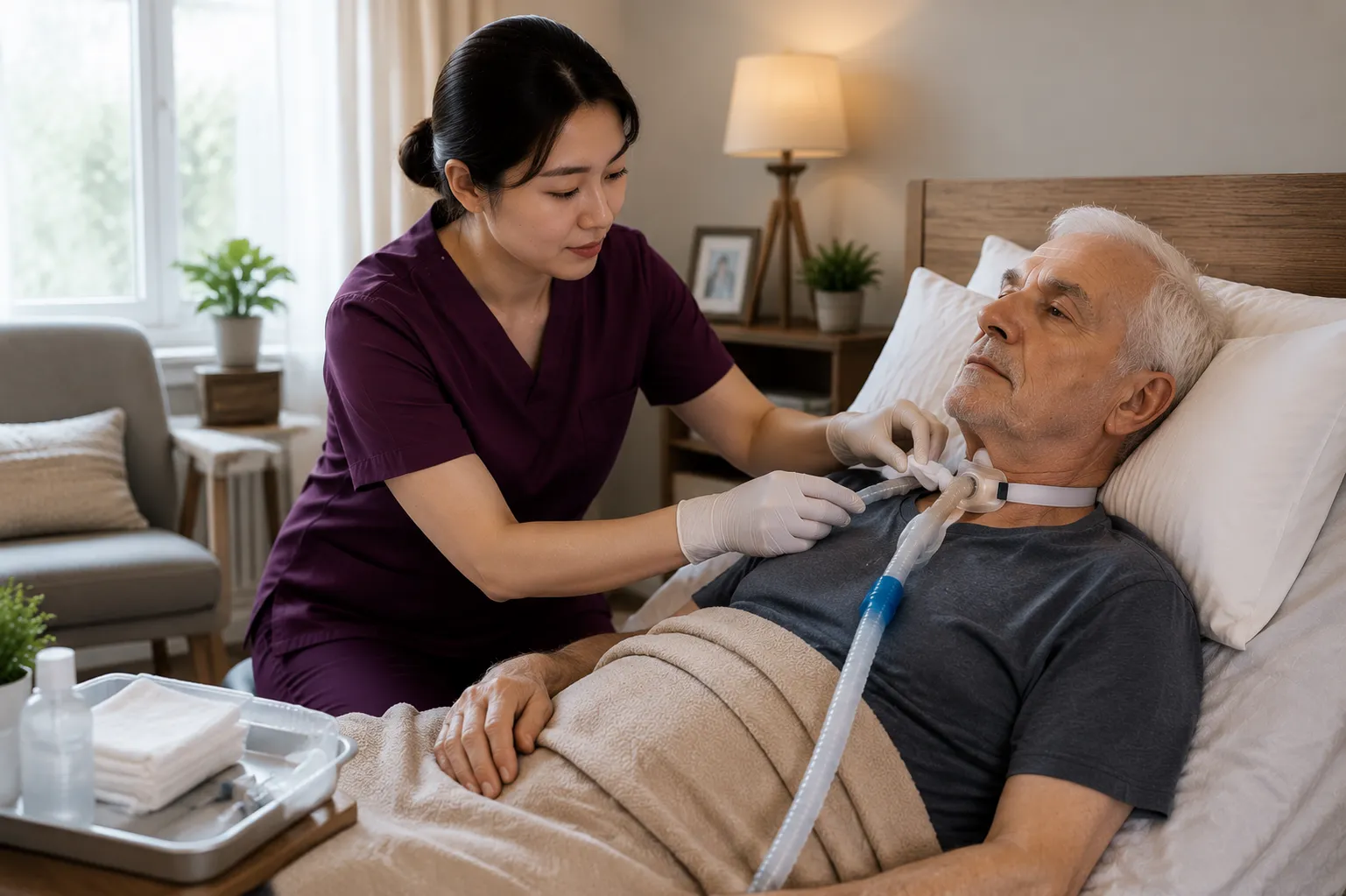
As the cough weakens, clearing normal mucus becomes harder, which raises the risk of chest infections. Community respiratory teams can teach manual chest-clearance techniques for family carers, and can provide a cough-assist machine (which mechanically supports an effective cough) or a portable suction unit for use at home, along with training on when and how to use them.
How Lifetouch Care’s community teams help
- Home visits to fit, adjust and troubleshoot NIV equipment, so most routine checks happen at home rather than requiring hospital trips
- Hands-on training for the person and family carers in mask care, machine settings, and recognising the early signs of a chest infection
- Joined-up planning between the respiratory team, MND nurse specialist and GP, so equipment and emergency contacts are already in place before a crisis — not arranged during one
- Ongoing, unhurried conversations about preferences for future breathing support, revisited gently as circumstances change

- New or worsening breathlessness lying down, or needing more pillows to sleep
- A cough that sounds wetter or weaker than usual, or difficulty clearing it
- Increasing morning headaches, drowsiness or confusion
Keeping a voice as speech changes
Most people with MND experience changes to speech at some point, and around three in four eventually lose the ability to speak clearly. Planning early keeps choice — and identity — firmly in the person’s own hands.
Why early referral matters
A speech and language therapist (SLT) is usually the first point of contact and should be involved as soon as any change in speech is noticed, even a mild one. Early input means strategies and equipment are in place before they’re urgently needed, and it allows time for voice banking — creating a synthetic voice built from recordings of the person’s own speech — or message banking, which involves recording specific meaningful phrases in their natural voice. These recordings can later be built into a communication device, preserving something recognisably personal long after natural speech has changed.
The full range of communication aids
Support spans from low-tech tools — alphabet or letter boards, picture charts, pen and paper — to high-tech speech-generating devices controlled by touch, head movement, or eye-gaze technology for people with very limited movement. The right option depends on current ability, fatigue levels, and what matters most to the individual day to day, and it’s reviewed regularly rather than fixed in place.
Supporting the people around them
Good communication is always a two-way effort. Training for family members and carers — allowing extra time, asking one question at a time, and resisting the urge to guess or finish sentences unless invited to — is often as valuable to daily conversation as the technology itself. Lifetouch Care carers receive this training as standard, so communication support is consistent whoever is in the home that day.
Emotional weight of losing speech
Speech carries far more than information — tone, humour and personality live in it too. Many people describe the loss of natural speech as one of the hardest parts of MND, separate from any physical difficulty. Acknowledging this openly, rather than focusing only on the practical replacement, is part of good communication care.
Ask about voice and message banking at the very first sign of any speech change — the recording process takes time and energy, so starting early gives the best-quality result while it’s least tiring.
Protecting nutrition when swallowing is affected
Difficulty chewing and swallowing (dysphagia) affects most people with MND at some stage. Left unmanaged, it can lead to weight loss, dehydration, exhaustion at mealtimes, and chest infections caused by food or drink entering the airway.
Spotting the early signs
Difficulty drinking thin fluids — plain tap water in particular — is often the very first sign of swallowing changes. Other clues include coughing or throat-clearing during meals, meals taking noticeably longer than they used to, unintended weight loss, and simply finding eating tiring rather than enjoyable.
First-line support
A dietitian and speech and language therapist typically work together on this from the outset. Early strategies include modifying food and drink texture (softer foods, thickened fluids), fortifying meals with extra protein and calories to counter reduced intake, adjusting posture during meals — such as a gentle chin-tuck to help protect the airway — and simply allowing more time and less pressure around eating.
When a feeding tube is discussed
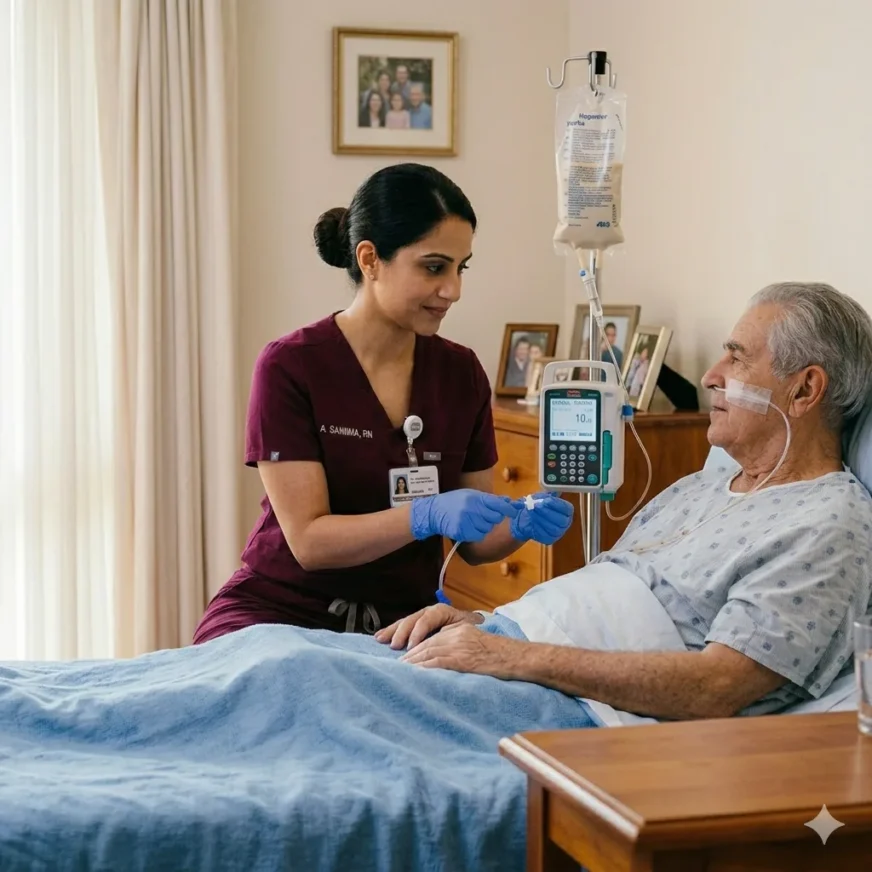
If swallowing becomes significantly harder, a gastrostomy tube (commonly placed via a PEG or RIG procedure) can deliver nutrition, fluids and medication directly to the stomach. This is usually raised as an option relatively early, often before it feels urgently needed, partly because the procedure carries less risk while breathing muscles are still stronger. Importantly, having a feeding tube doesn’t automatically mean giving up eating by mouth altogether — many people continue enjoying small amounts of favourite foods for taste and social connection, with the tube providing the underlying nutritional safety net.
Hydration matters too
Dehydration is easy to overlook once thickened fluids replace plain water, since people often drink less overall. Carers are trained to track fluid intake alongside food, and to flag any signs of dehydration such as dark urine, dizziness, or increasing confusion.
How Lifetouch Care’s community teams help
- Home visits from dietitians to review weight, intake and adjust feeding plans as needs change
- Carers and district nurses trained to manage and troubleshoot feeding tubes safely at home
- Joint working with SLT so swallowing safety and communication needs are considered together, since both shape quality of life at mealtimes
- Mealtime companionship, not just feeding support — preserving the social and enjoyable side of eating for as long as possible
Adapting the home as movement changes
Muscle weakness affects arms, legs and trunk at different rates for different people. Occupational therapy and physiotherapy help maintain independence and safety for as long as possible, and adapt the home environment ahead of need rather than after a fall or crisis.
Staying mobile, safely
Physiotherapists help maintain muscle flexibility, manage stiffness and spasticity, and advise on safe movement and transfer techniques. Occupational therapists focus on adapting how daily tasks are done — from cutlery and dressing aids to bathroom rails, riser-recliner chairs, hospital beds and hoists — always aiming to preserve as much independence and comfort as possible.
Timing matters
Ordering and installing equipment, or arranging home adaptations such as a stairlift or wet room, can take weeks. Introducing these conversations proactively — before they’re urgently needed — avoids periods where someone is unsafe or housebound while waiting for equipment to arrive.
Wheelchairs and seating
As walking becomes harder, a wheelchair assessment considers posture, pressure care, and how the chair will work alongside communication devices or ventilation equipment, since these often need to be used together.
How Lifetouch Care helps
- Home assessments carried out early, with equipment reviewed and updated as needs progress
- Coordinated ordering of equipment through occupational therapy and community equipment services
- Carer training in safe moving and handling techniques to protect both the person and the carer
- Regular reassessment, since MND rarely progresses at a steady, predictable pace
Caring for the person behind the diagnosis
A diagnosis of MND affects identity, relationships and mental health, not just the body. Emotional support is not a “nice extra” alongside physical care — it’s a core part of a well-run care plan.
Common emotional experiences
Grief, anger, anxiety about the future, and low mood are all common and understandable responses to living with MND, both for the person diagnosed and for the family around them. Some people also experience changes in mood or cognition as a direct effect of the disease itself, which is worth discussing openly with the clinical team rather than assuming it’s purely situational.
Who provides this support
Clinical psychologists, counsellors, MND nurse specialists, chaplaincy and hospice teams can all play a role, and referral pathways exist specifically for people living with progressive neurological conditions. Peer support — connecting with others who have lived experience of MND — is often valued as much as professional input.
Maintaining identity and connection
Simple things carry weight: being asked for an opinion, being included in decisions, continuing hobbies in adapted form, and being spoken to directly rather than through a carer. Good community care actively protects these moments rather than letting physical care needs crowd them out.
One team, coordinated around the person
Because MND touches so many abilities at once, care works best when it’s coordinated by a multidisciplinary team (MDT) that follows the person across hospital, hospice and home — rather than separate specialists working in isolation.
What good community care looks like
- A single point of contact — usually an MND nurse specialist or Lifetouch Care key worker — so the person and family aren’t left coordinating between departments themselves
- Home and community clinics, including hospice day services, bringing several specialists together in one visit rather than repeat hospital trips
- Equipment provision — wheelchairs, hospital beds, hoists, communication devices — arranged proactively as needs change, not only in a crisis
- Early palliative care involvement, which in MND is about maximising comfort and quality of life from diagnosis onward, not only end-of-life care
- Advance care planning conversations started while the person can fully take part in decisions
- Carer support — training, respite options, and emotional and bereavement support recognised as part of the care plan, not an afterthought
Why this matters day to day
Fragmented care — where respiratory, nutrition and communication needs are managed by separate teams that don’t talk to each other — is one of the most common frustrations families report. A properly coordinated MDT means changes in one area (say, poor sleep from breathing difficulty) are recognised as connected to another (reduced energy for meals or communication practice), and the whole care plan adapts together rather than in disconnected pieces.
National charities and MND associations often sit alongside the clinical team too, offering equipment loans, peer support, and guidance for navigating benefits and care funding — practical support that complements the medical side of care.
Supporting families, and planning with confidence
Family carers often provide the majority of day-to-day support, and their own wellbeing directly affects the quality of care they can give. Meanwhile, planning ahead — while it can feel difficult to raise — gives everyone more control, not less.
Short breaks, whether a few hours or a planned stay, protect a carer’s own health and prevent burnout over the long term.
Confidence with equipment, feeding, and moving and handling reduces stress and physical strain for family carers.
Conversations about future breathing support, feeding decisions and preferred place of care, held early and revisited over time.
Emotional and practical support for families continues beyond the person’s death, recognised as part of the care relationship.
Raising topics like future ventilation support or preferred place of care doesn’t need to happen all at once, and it doesn’t take away hope. Done well, it’s a series of honest, unhurried conversations — started while the person can fully participate — that make sure care always reflects what they’d actually want, even if they later can’t say so themselves.
Speak with the Lifetouch Care team
Our community nurses and specialist carers coordinate respiratory, communication, nutrition and emotional support around each person’s own home and routine.
Get in touchThis article is provided for general information only and does not replace advice from a qualified healthcare professional. Every experience of MND is different — always discuss symptoms, equipment and care decisions with the person’s own multidisciplinary team.