

Lifetouch Care provides nurse-led ventilator support at home, enabling individuals with long-term respiratory needs to live safely, comfortably, and confidently in familiar surroundings. Our registered nurses are skilled in managing both invasive and non-invasive ventilation, ensuring airway patency, monitoring oxygen levels, and responding promptly to any changes in respiratory status.
We oversee every aspect of ventilator management, including setup, routine safety checks, humidification, suctioning, and emergency protocols, while maintaining calm, reassuring communication throughout. Families are supported with clear, accessible education so they feel confident and involved in their loved one’s care.
Every care plan is personalised to the individual’s condition, preferences, and lifestyle, with full CQC-aligned governance and clinical oversight. Our approach blends clinical precision with genuine compassion, ensuring continuity, comfort, and peace of mind for both clients and their families.
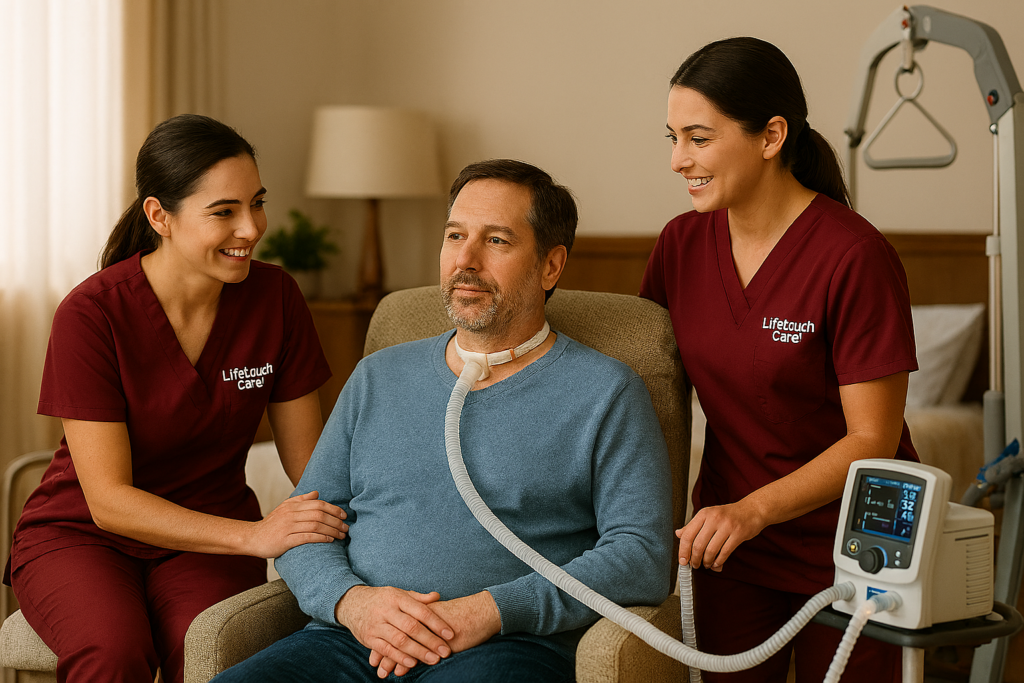
People living at home with invasive ventilation need a level of support that combines airway safety, equipment reliability, and continuous clinical awareness. Lifetouch Care delivers this through a nurse-led model where trained staff manage day-to-day care while nurses provide oversight, escalation planning, and clinical governance. The focus is on maintaining a secure airway, monitoring breathing patterns, managing secretions, and ensuring the ventilator and tubing remain clean, patent, and functioning. Staff observe for any signs of respiratory distress, infection, or equipment malfunction and escalate concerns promptly to community nurses, respiratory teams, or emergency services when needed. This approach helps keep people stable at home while preserving dignity, comfort, and quality of life.
Training is central to how Lifetouch Care supports individuals on invasive ventilation. Carers only undertake tasks they have been formally trained and signed off as competent to perform, such as routine suctioning, humidification checks, tracheostomy site care, and safe handling of ventilator equipment. Nurses deliver structured competency-based training, refreshers, and supervision, ensuring staff understand red flags, infection prevention practices, communication support, and emergency procedures. This combination of skilled training, clinical oversight, and compassionate daily care allows Lifetouch Care to safely support people with complex respiratory needs in the community and reduce avoidable hospital admissions.
Lifetouch Care supports people on non-invasive ventilation (NIV) in the community by combining clinical oversight with day-to-day practical care that keeps the person safe, comfortable, and stable at home. The focus is on maintaining effective ventilation, preventing deterioration, and ensuring the person can live well outside the hospital. This includes observing breathing patterns, checking comfort and tolerance of the mask, monitoring for signs of CO₂ retention or fatigue, and ensuring the equipment is clean, functioning, and free from leaks or blockages. Staff also look after skin integrity around the mask, support positioning for optimal breathing, and document any changes so nurses and respiratory teams can review concerns early.
Within Lifetouch Care’s nurse-led model, NIV support is delivered through a structured, clinically governed approach. Nurses provide assessment, escalation planning, and competency-based delegation, while trained carers assist with comfort, hydration, routine, and recognising red flags. The service works closely with home ventilation teams, GPs, and community nurses to ensure settings are only adjusted by qualified clinicians and that any deterioration is escalated promptly. This blend of clinical governance and compassionate, human-centred support allows Lifetouch Care to keep people safely at home, reduce avoidable admissions, and maintain dignity and independence for individuals who rely on NIV.
The focus is on maintaining effective ventilation, preventing deterioration, and ensuring the person can live well outside the hospital.